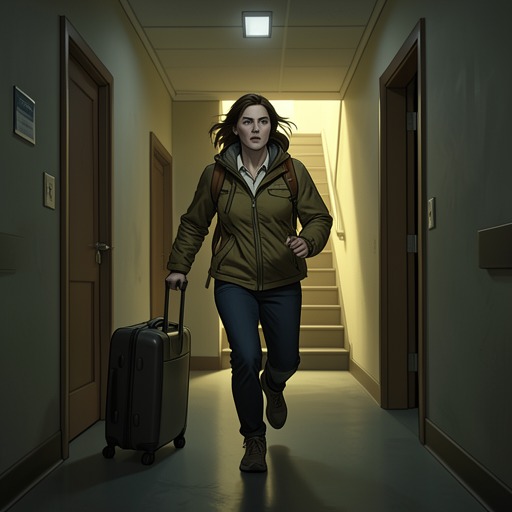
Lo is imprisoned in the Aurora’s hidden cabin
The Woman in Cabin 10Laura Blacklock’s imprisonment in a hidden cabin aboard the Aurora Borealis is the consequence of discovering the deception surrounding Anne Bullmer: the cabin confines her physically while the people responsible try to keep her from revealing what she knows. Trapped below deck, Laura must weigh the slim chance of release against the growing likelihood that her captors intend to silence her permanently.
Discovery and Confinement
Laura’s understanding of why she has been imprisoned develops alongside her recognition of how she inadvertently found the hidden cabin. She realizes that her unusual knock may have acted as a prearranged signal, prompting the occupant to open the door. Had she knocked just once or twice, she thinks, she might never have discovered the woman inside—or been locked away and silenced as a result. The moment recasts an ordinary visit as the accident that placed her in danger.
The cabin’s location gives its secrecy practical force. Laura recognizes that Anne’s apparent access to passkeys and staff areas, and to the locked space in the ship’s hidden lower reaches, makes sense if the ship’s owner has unrestricted access. Her imprisonment is therefore not simply a matter of being shut in a room: it occurs within a concealed part of the vessel, beyond the ordinary spaces where passengers might look for her.
As the hours pass without a return, Laura sees little reason to expect release. She knows about Anne’s concealed identity and doubts anyone would believe her account of being kidnapped, imprisoned, and physically harmed. The blood caked on her cheek, left after she was struck against a doorframe, makes the danger immediate; confined in a space she describes as a two-metre coffin, she has little control over her circumstances beyond trying to keep clean.
The Captivity and Richard’s Deception
Laura’s confinement becomes more intelligible as she pieces together what the hidden cabin and the disguised woman reveal. Anne had access to passkeys, staff areas, and the locked space beneath the ship because Richard owned the vessel; the cabin was not merely a concealed room but part of an arrangement that allowed a hidden passenger to move beyond ordinary scrutiny. Laura also understands why Richard prohibited photographs of Anne: the woman presented publicly as his wife was an impostor, and a picture might later expose the substitution. Anne herself, she concludes, had been dead since the night the ship left England.
The captive woman’s account identifies her as Carrie, who had met Richard at The Magellan while working as a waitress and trying to become an actress. Carrie describes being swept into a life she had not known, while accepting that Richard was married and keeping their relationship secret. She believed that Anne was cold and controlling, that the couple lived apart between Norway and London, and that Richard could not bring himself to divorce a wife supposedly close to death. His promises that they would be together after Anne died helped make the deception seem like a path to a future rather than a crime.
Carrie says Richard arranged for a guest not to appear, leaving an empty cabin where she could impersonate Anne. The role required her to cut her hair, wear Anne’s clothes, and remain disguised until the final day, when she expected to change back and go home as herself. On the first night, Richard came to the cabin in distress and told Carrie that Anne had discovered their affair, struck out at him, and died after he pushed her away and she hit her head on a coffee table. He persuaded Carrie that they must dispose of Anne’s body at sea and continue the plan, claiming that otherwise the police would uncover Carrie’s presence and treat them as conspirators.
Laura sees gaps in this explanation that Carrie appears unwilling to confront. The ship was not due to reach Norway until the following day, and Anne could not plausibly have left the vessel at the time Carrie’s story implied; there was also the problem of her passport and the crew’s awareness. To Laura, the mismatch suggests that Richard had never intended Anne to walk ashore. Carrie’s uncertainty about trusting anyone on board—including people who might see Richard as their employer—helps explain why she does not simply disclose the truth, but it also leaves Laura isolated with knowledge that makes her own release dangerous.
Laura presses Carrie to consider what will happen once Richard has Anne’s money, warning that he may next make himself safe by eliminating Carrie. Carrie insists that Richard loves her and rejects the prospect that he would turn on her. The exchange makes the cabin a place of argument as well as confinement: Laura tries to make her captor recognize that the same man whose story she has accepted may treat her as expendable. Her appeal does not immediately end the imprisonment; after Carrie leaves, the hours pass without her return, supper does not arrive, and Laura fears that she has made a fatal mistake by trying to create trust.
The Captive’s Choice
The waiting tests Laura’s ability to hold on to ordinary habits. The cabin’s electricity remains on, though she cannot tell whether Carrie has left it that way deliberately or simply forgotten. Laura showers again, licks dried croissant jam from a plate, and tries to occupy her mind by reconstructing the house where she grew up and recalling the plot of Little Women. The book she had packed as a protective charm offers no familiar comfort now; its well-known words cannot displace her thoughts about the woman who has imprisoned her.
Laura eventually sees her escape as a choice between accepting Carrie’s help and attempting to get out without it. Carrie has beaten, confined, and starved her, but Laura recalls the care in the way Carrie helped her sit and waited while she ate, as well as the sadness in her face when she left. Those gestures do not undo the violence or make Carrie trustworthy. They do, however, leave Laura wondering whether Carrie is capable of killing her by choice—and whether the delay has been tormenting Carrie as well as her captive. When Carrie returns with stolen food, Laura reads the act as evidence that her resolve may be weakening.
Carrie remains afraid to reveal herself to anyone aboard. She cannot know whom she can trust, and believes that the people who think she is Anne might see her as a stranger admitting that the real Anne was pushed from the ship; Richard’s position as their employer makes disclosure seem still more dangerous. Rather than seek help openly, Carrie says she has a plan and begins a clothes exchange: she gives Laura her silks and asks for Laura’s clothes. The gesture turns their uneasy personal alliance into a practical possibility of escape, while leaving its risks—and Carrie’s intentions—unsettled.
The Disguise and the Limits of Recognition
The deception depended on making the same face signify two different people. Laura had first seen the woman presented as Anne Bullmer in a scarf covering her scalp, without eyebrows, with pale skin and jutting cheekbones that made her look gravely ill. Anne had said she was exhausted, had finished a round of chemotherapy, and expected radiotherapy after the voyage; on another evening, a bruise on her collarbone was explained as a side effect of treatment and easy bruising. Later, the woman’s dark hair and pencilled eyebrows transformed that appearance so completely that Laura struggled to reconcile the healthy-looking figure with the gaunt one she had met. The resemblance was sufficient in height, weight, and broad cheekbones, while the difference in the eyes went unnoticed because no one aboard had known Anne before the trip. For Laura, this change makes the imprisonment’s logic legible: the identity she had trusted as a passenger was itself a performance, maintained by controlling what others could see and remember.